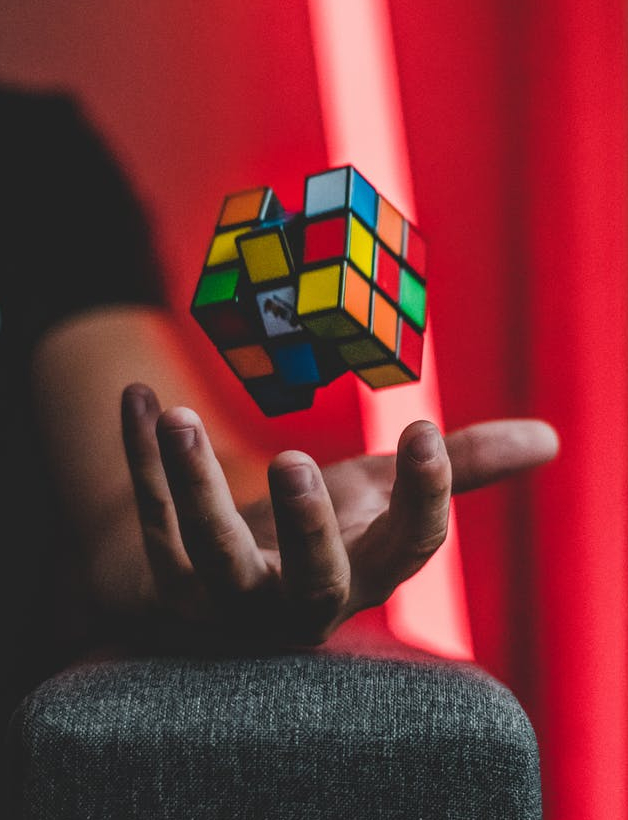
So what’s a soul object? To be honest before December this year, I had never heard of the term. However having been asked to pick one, I had to think deeply about what my object would be. After much musing, it led to quite simple a realisation and more on this later.
So why did the subject come up to begin with, you may be wondering? Well I was asked to submit a photo of ‘mine’ for our company Christmas party (online this year due to Covid), amongst other competition categories, such as the ‘most amusing’ lock-down selfie. The ‘winner’ would be the one who most accurately matched their object to their personality, according to the judges of course.
We had a couple of weeks to think on it and whilst it didn’t occupy all of my thoughts, I must admit I found the whole topic quite intriguing. So firstly, being decidedly lazy and having not had much inspiration, I decided to look up what a soul object is – in case there was a handy online self-questionnaire that if filled out, would give me the answer. I kinda figured someone would have produced one, similar to the “what’s your punk rock band name” generator, where you are asked to combine the last food you ate and the colour of pants you’re wearing. It seems after much searching, there’s not actually much on the web to guide you, so that was a bit of a fail I thought.
The next tack was to try to describe myself and see if those words led me in a specific direction. “Intelligent”, “funny”, “hardworking” were some of the first words that sprang to mind. Ok, so not much inspiration was found on that front either. I also quickly discounted things such as Louboutin shoes, Prada handbags and like, as the thought of being defined by a label didn’t seem to fit either. Large objects such as the Eiffel tower, or the Sputnik spacecraft also didn’t seem right, they felt grandiose and outlandish as ‘objects’.
So being rather laterally minded, I then thought of the objects that had most intrigued, inspired, or impacted my upbringing. And very quickly the Rubik’s cube sprang to mind. Almost instantaneously. So being one of deep thought, I then wondered why it had so quickly arrived in mind and immediately felt so right.
The short reason is that it arrives on the planet perfectly formed, stays a wee while like that, but then very quickly gets all a bit jumbled up. However, every now again someone with skill and practise can make it perfect again, but actually, it really is ok just sitting there most of the time a bit out of sorts. It’s arguably a work of art to some, it’s a bit ‘meh’ to others, but to me, it’s perfectly imperfect 🙂
Ah….. perfectly imperfect. That was it, that’s why it fitted. And so here comes the first part of the realisation. I’ve been having counseling for over a year now due to a difficult period of work-related stress that I went through in late 2019. Over this time, my counselor has taken me through a long and slow period of helping me to rebuild me, of careful questioning and support to eventually make me realise (and truly believe) it was ok NOT TO BE PERFECT. Moreover to celebrate that imperfection. To be human.
Sam introduced me to the concept of ‘Wabi Sabi’. Contrary to what I thought it was, it’s not related to wasabi or sushi. Though it is of Japanese origin and is sometimes described as one of appreciating beauty that is “imperfect, impermanent, and incomplete” in nature.[3]
Having looked it up on wikipedia, “Wabi” connotes rustic simplicity, freshness or quietness, and can be applied to both natural and human-made objects as an expression of ‘understated elegance’. It can also be used to refer to the quirks and anomalies that arise from the process of making something, which are seen to add uniqueness and elegance to the finished object. “Sabi” refers to the beauty or serenity that comes with age, when the life of the object and its impermanence are evidenced in its patina and wear, or in any visible repairs. In short, it is typically defined as “flawed beauty”.
Indeed, as my Counselor carried on to explain, a good example of Wabi Sabi may be seen in a Japanese tea ceremony, as the pottery items used are often rustic and simple looking. However their flaws, obtained over a period of regular use, are celebrated, as that use has provided pleasure via the ceremony itself . At first I wasn’t getting it, so he then went on to show me the picture below and bingo, it clicked. Not only did it click, it resonated with me so greatly, that I printed it out and stuck it to the wall next to my work computer.
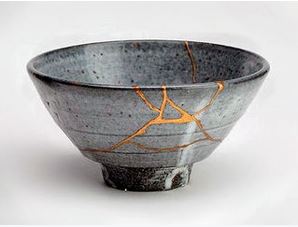
Now every time I start to get stressed or anxious at work, I look at the picture of the bowl, take a deep breath and say to myself ‘perfectly imperfect’ and I tend to cope much better with the issue at hand. As in that moment I realise all is ok. That yes, I do work hard, yes I am intelligent, but yes, I accept with all my beautiful imperfections that I am only human. Things go wrong, they don’t always go well, maybe the problem wasn’t solved fully this time. But it’s ok – just as it is.
And so I went on to further read that wabi-sabi is a training whereby the student of wabi-sabi learns to find the most basic, natural objects interesting, fascinating and beautiful. Fading autumn leaves would be an example – which is a theme that arises in my earlier Blog post ‘A Winter’s Lesson’. Indeed Wabi-sabi can change our perception of the world to the extent that a chip or crack in a vase actually makes it more interesting and moreover, gives that object greater value.
Another way of looking at this whole topic would be to read up on Winnicott’s ‘Good Enough Mother’ theory, and I suggest you start with his wiki entry here. I actually prefer the Wabi Sabi approach myself, but it’s all good stuff if you suffer from any anxiety or stress caused by a degree of perfectionism in your life.
So what did I learn overall though? To the extent a Rubik’s cube is an example of an object that in any way reflects my personality, I entered picture of it into the competition and lost out to a colleague who completely and utterly took the piss out of himself with his object. The realization being that perhaps I also need to sometimes not take myself so seriously and just have a bit of fun sometimes.
 All Things Bright and Beautiful...
A great read. Another great application of Wabi-Sabi is to think of it as a mindfulness exercise to look for (and always incidentally you happen to find) beautiful ‘flaws’ in what you previously considered ‘perfect’.
LikeLiked by 1 person