I’ve mentioned the term ‘imposter syndrome’ in at least one of my other blogs and it’s a topic I’ve spoken on camera about at least once. So what is it?
To be honest, until a couple of years ago, I didn’t know what it was either. Then in circa 2015, I was picked to attend a senior leadership training course, to be held in Shanghai, China (of all places). Prior to going, I had to fill in a number of psychological questionnaires, or profiles, if you will. Analysis of those replies by the course leaders, resulted in an ‘imposter syndrome’ discovery (amongst other things).
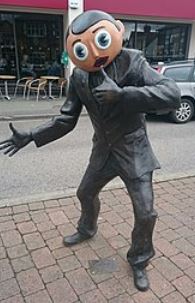
So when I first realized I had (or perhaps better put, ‘exhibited’) imposter syndrome on that program, luckily I wasn’t the only one. And once ‘discovered’, it was shared, and certainly then, more understood. I also immediately named my imposter ‘persona’, so to speak, ‘Frank’ after the character Frank Sidebottom1. Though to this day I have no idea why, the name just came to me and it felt right, and has stuck ever since.
Anyway, simply put, imposter syndrome (IS) is the experience of feeling like a phony—you feel as though at any moment you are going to be ‘found out’ as a fraud—like you don’t belong where you are, and you only got there through sheer luck, or because you haven’t messed up (yet). It’s also known as the ‘impostor phenomenon’, though it isn’t where you try to pretend to be someone else (that just me being me imagining I’m Charlize Theron in her latest movie).
So moving on…… the term was first used by psychologists Suzanna Imes and Pauline Rose Clance in the 1970s. When the concept of IS was introduced, it was originally thought to apply mostly to high-achieving women. Since then, it has been recognized as more widely experienced and I’ve certainly met quite a few male colleagues who have openly admitted they feel the same way too.
Sound familiar, but how do you tell if this is you too? Well, having done some reading and met some experts including Kate Atkin, some of the common signs of imposter syndrome usually include:
- Self-doubt or a fear that you won’t live up to other’s expectations
- An inability to realistically assess your competence and skills, or regularly berating your own performance
- Overachieving or setting very challenging goals and then feeling disappointed when you fall short
- Attributing your success to external factors, even sabotaging your own success
While for some people, IS can provide the drive and motivation needed to achieve, this usually comes at a cost in the form of constant anxiety. You might over-prepare, or work much harder at something than is necessary to “make sure” that nobody finds out you are a fraud. This sets up a vicious cycle, in which you think that the only reason you survived that presentation at work was that you stayed up all night rehearsing. In this respect, your core beliefs about yourself are so strong, that they don’t change, even when there is evidence to the contrary. The thought process goes along the lines of: “If you do well, it must be the result of luck, because an incompetent person just doesn’t belong”. Certainly it is clear from all my reflections on the topic, perfectionism plays a significant role in impostor syndrome. This is certainly one of the ways it exhibits itself in me. Constant anxiety is also my ‘normal’.
While impostor syndrome is not a recognized disorder in the Diagnostic and Statistical Manual of Mental Disorders (DSM-5), it is certainly not uncommon. The negative thinking, self-doubt, and self-sabotage that often characterize imposter syndrome can have an effect on many areas of your life. Low self-esteem, or low self confidence, can be related, as well as high levels of controlling behavior (needing to control everything around you for fear of failure, or letting somebody down). If you often find yourself feeling like this, it may be really helpful to talk to a therapist, or counselor. In the UK, you can get help via a referral from your GP to the NHS Well-Being Service (although it does take a while, it is worth it). If you want to go privately, or don’t have access to the NHS, I recommend you start with a registered practitioner, and in the UK the BACP is the main governing structure.
The NHS route was the one I was sent down by my GP, (however in all transparency, I was also lucky enough to be able to afford to go privately also) and after waiting a wee while via the NHS, I was given a series of 12 sessions of CBT (Cognitive Behavioral Therapy). Which, whilst it sound very grandiose and scary, was actually absolutely fantastic for me in this respect and helped me realise some of the underlying core beliefs and repetitive behaviors that contributed to my perfectionism, self doubt and thus, my stress and anxiety.
During those 12 weeks of CBT, I was taken through a program of looking closely (and sometimes very painfully) at my self-esteem. And I was asked to really think about myself by reflecting on some really pointed questions, such as:
“What core beliefs do I hold about myself?”
“Do I believe I am worthy of love, just as I am?”
“Must I be ‘perfect’ for others to approve of me?”
“What negative thought patterns about myself do I regularly fall into?”
By working through various cycles of question, response, discussion, refection and reframing, I slowly managed to understand the underlying reasons, the triggers and unhelpful patterns of behavior causing the negative feelings and thus, constant anxiety. I was shown that I needed to allow myself some self-love, a break from being so hard on myself once in a while. To not only accept that I’m not perfect, and didn’t need to be, but to move to a place of actually being able to celebrate my imperfections – and on this topic I’ve already written a blog post Why a Rubik’s cube is my ‘soul object’.
Whilst my imposter syndrome is not totally ‘cured’ and probably never will be, I find it easier to understand why and how I react to certain things at work and at home, and to be much easier on myself. To be able to lower my standards and still do a good job, or be a good enough mother/wife/friend/sister/daughter. Not to tear myself apart when I make a mistake, or berate myself for saying or doing the wrong thing at the wrong moment.
And as for Frank? Well he’s still there, as his statue is still on Timperley village high street, but he appears less often now-a-days and we have a much better, more balanced relationship. He can help to provide the drive when I need it, but I can also spot when he is taking too much control. As for the anxiety? It’s still there too, again probably always will be, but it’s at a much lower, much more healthy level.
So what’s your imposter called?
[1] For those readers who don’t know who Frank Sidebottom is, see here more more information about his creator Chris Sievey here. BTW I certainly do not meant to imply Chris/Frank was an imposter, or offend any die hard fans of his (as it is I grew up in Sale, Cheshire, so have a deep affection for the character).
 All Things Bright and Beautiful...
2 thoughts on “An imposter called Frank”